

Lumbar Fusion
A lumbar fusion is performed when the spine is unstable, misaligned, or both. By restoring proper alignment and allowing two or more vertebrae to heal together into a single solid segment, lumbar fusion can relieve pain, improve function, and create a more stable foundation for movement.
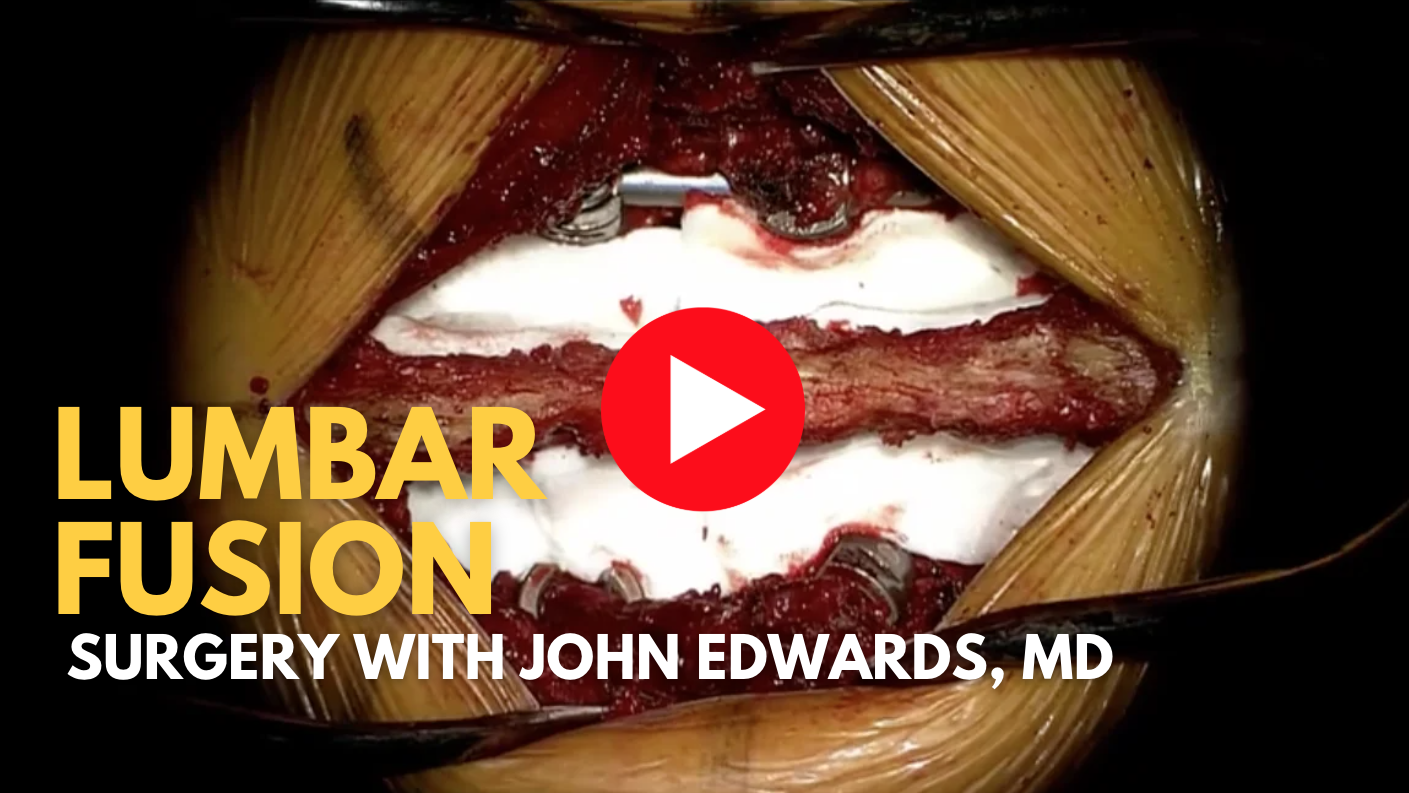
-
A lumbar fusion is designed to stabilize the spine when there is abnormal movement or alignment between vertebrae.
Common reasons for lumbar fusion include:
Spinal instability
Vertebral slippage (spondylolisthesis)
Scoliosis
Spinal fractures
Other conditions that affect spinal alignment
In addition to stabilizing the spine, lumbar fusion often includes decompressing pinched nerves to relieve leg pain, numbness, or weakness.
-
Lumbar fusion is performed under general anesthesia, most commonly through the back of the spine.
During surgery:
Advanced neuronavigation technology is used to precisely place screws and hardware
The spine is restored to proper alignment and stabilized
Bone graft material is placed to encourage the bones to fuse together over time
In many cases, the damaged disc is removed and replaced with a spacer (cage) and bone graft
Pinched nerves are decompressed to relieve pressure and improve symptoms
Most patients spend one night in the hospital and return home the following day.
-
Recovery varies depending on the extent of the fusion and the patient’s overall health.
Hospital Stay
Typically one night in the hospital
Most patients return home the day after surgery
First Few Weeks
Walking and movement are encouraged immediately
Activity should increase gradually and incrementally
3-4 Months
Most patients return to normal daily activities
Healing and fusion continue during this period
Your surgeon will provide personalized recommendations based on your procedure and recovery progress.
-
The goal of lumbar fusion is to improve spinal stability, relieve nerve compression, and restore function.
Many patients experience:
Significant reduction in back and leg pain
Improved mobility and quality of life
Better tolerance for daily activities and exercise
After healing, many patients return to activities such as:
Hiking
Biking
Skiing
Running
Travel
Recreational sports
For most patients, the surgery allows them to do more than they were able to do before surgery, not less.
-
Every surgery carries risks, though serious complications are uncommon.
During Surgery
Spinal fluid leak (approximately 2%)
Nerve injury (less than 2%)
Hardware malposition (rare)
After Surgery
Infection
Fluid collection that may require additional treatment or surgery
Failure of the bones to fuse completely (nonunion)
Nonunion occurs in approximately 1 in 10 patients and may require additional monitoring or treatment.
Future Surgery
Some patients may require another spine surgery in the future. Long-term studies suggest approximately 20% of patients undergo an additional spine procedure within 10 years. Maintaining strong muscles, healthy bones, and good body mechanics can help support long-term spine health.
ADDITIONAL RESOURCES
-
![]()
What is a Lumbar Fusion?
The goal of lumbar fusion is to restore stability, reduce pain, and help you return to the activities that matter most
-
![]()
Preparing for a Lumbar Fusion
A lumbar fusion is designed to stabilize the spine when there is abnormal movement or alignment between vertebrae.
-
![]()
Bone Grafts in Fusion Surgery
At the 2025 Summit, Orthopedic Surgeon Dr. Sage spoke on the current landscape of bone grafts in fusion surgery.

Patient Stories
Summit Stories — Becky Manwaring
Meet Becky — survivor of a terrible car crash. After 6 years of trying to find a solution for her pain, she was able to have a fusion. After 2 months, she is finally getting her life back. Being a mother, enjoying her children, going on adventures, and getting back to day to day life rituals that make her life full, Becky shows us that pain is never the solution. Thank you Becky.
Summit Stories — Kim Crowley
Meet Kim Crowley, a lifelong adventurer who found love on the slopes and overcame back pain with the Karma procedure by Dr. Brian Anderson. Her inspiring journey from marathon runner to pain-free living highlights the transformative power of innovative healthcare.
Summit Stories — Brett Johnson
Meet Brett Johnson: a lifelong runner and 26-year military veteran who, after back and knee surgeries, defied the odds to complete his 30th St. George Marathon. Through resilience and hard work, Brett found a renewed life, embracing trails and marathons with his grandkids by his side. His story is a powerful reminder: life after surgery is not only possible but can be even richer if you’re willing to put in the effort. ‘We’re not meant to leave this life with a pristine body; live it fully and wear it out,’ Brett says, inspiring all of us to chase beauty beyond the hard trails.
Summit Stories — Charles Cox
Meet Charles, a hard working father, grandfather and neighbor who has been experiencing back pain for 6 years. Charles fought surgery for a long time, working with our partners in the community to try to diminish the pain and heal with non-surgical options. However, Charles decided that he no longer wanted to live in pain. Post surgery Charles is traveling, exercising and enjoying his life again. We are lucky to know someone as wonderful as he is.
Summit Stories — David Heslington
For 42 years, David has played the Grubstake in Park City. He started guitar at 8 years old, performing by 12, hauling heavy gear through decades of late nights and long sets. Music has never just been a job. It has been his life. Today, he is still doing what he loves most. Walking a mile. Bending down without fear. Playing beside longtime friends. Greeting regulars who have grown up with his sound. For David, success is simple. Keep playing. Keep moving. Keep the music going.